
Best Power Bank Kuwait 2026: Anker, UGREEN and Lisa & Gary for Phones, Laptops and Camping
Never Hit 1% Again
The right capacity, delivered across Kuwait
You bought a power bank rated 10,000mAh and it only charges your phone one and a half times? The printed number never reaches your device in full: after voltage conversion and heat losses you get around 6,500mAh. That is why so many people in Kuwait think their power bank is "weak" when it is performing exactly as designed. On Sheeel you will find power banks from Anker, UGREEN, Xiaomi, Lisa & Gary and Porodo, so you can match capacity and wattage to your phone, laptop or camping trip.
Why is the printed capacity on a power bank bigger than what you get?
The battery cells inside a power bank run at 3.7V, while USB charging needs 5V or higher. Stepping that voltage up consumes part of the stored energy and turns it into heat. The result is a loss of roughly 30% to 35% of the advertised capacity before a single milliamp reaches your phone.
This is physics, not a defect or a marketing trick, and it applies to every brand without exception. What separates a good power bank from a cheap one is that a good one loses 30% while a cheap one loses 40% or more, and that a good one still performs after 500 charge cycles while a cheap one starts fading after 150.
Quick maths: a modern iPhone battery is around 4,000mAh. A 10,000mAh bank refills it about one and a half times, not two and a half.How to choose a power bank for your use
1. How many mAh do you need?
Do not default to the biggest number available. More capacity means more weight, more bulk, and a much longer time to recharge the bank itself.
- 5,000mAh: roughly one full charge. Pocketable, ideal for the office, university and errands around the city.
- 10,000mAh: one and a half to two charges. The best balance of size and usefulness for daily carry.
- 20,000 to 25,000mAh: three or more charges, and enough to run a laptop if the wattage is high. Built for travel and long days out.
- 50,000mAh and above: for camping, desert trips and emergencies. Heavy, and not something you carry every day.
2. How many watts does your device need?
Capacity tells you how many times you can charge. Wattage tells you how fast. A 20,000mAh bank rated at 10W will trickle-charge your phone at an irritating pace, while 20W or more with PD support gives you genuine fast charging.
- 20W to 22.5W: the practical minimum for fast-charging a modern phone.
- 33W to 45W: comfortable for phones and tablets together.
- 65W and above: required if you intend to charge a laptop or MacBook.
3. Which ports and cables should you pick?
Newer models include a built-in or retractable cable, and this matters more than you would expect — forget your cable at home once and you will understand why. If you use an iPhone with MagSafe, a magnetic power bank snaps onto the back of the phone and charges wirelessly with no cable at all.
Best power banks in Kuwait: Anker, UGREEN, Xiaomi and Lisa & Gary
We picked eight models covering every use case, from something that disappears into a pocket to something that can keep a whole camp running. Every link goes straight to the product page on Sheeel so you can check current availability and pricing.

Anker 25,000mAh - 165W
The most-bought unit in the category. Charges four devices at once at up to 165W, enough for a laptop. One retractable USB-C cable extends to 70cm and a second doubles as a lanyard rated to 20kg, with a smart display showing charge level and time remaining. Flight approved.
Check Current Price
Anker Nano 5,000mAh - 22.5W
The smallest and lightest option here. A foldable built-in USB-C connector plugs straight into the phone with no cable whatsoever, and 22.5W delivers real fast charging. Slips into a trouser pocket without a thought.
Check Current Price
SIA MagOn Magnetic 10,000mAh
Snaps onto the back of an iPhone with an N52-grade magnet and charges wirelessly at 15W with no cable, plus a 20W USB-C port for faster wired charging. Solid metal housing and full MagSafe compatibility.
Check Current Price
Xiaomi 20,000mAh - 33W
The most balanced daily-carry choice. A built-in USB-C cable plus extra ports let you charge several devices at once, and 33W suits both phones and tablets. At 127 x 71 x 31mm it fits any bag.
Check Current Price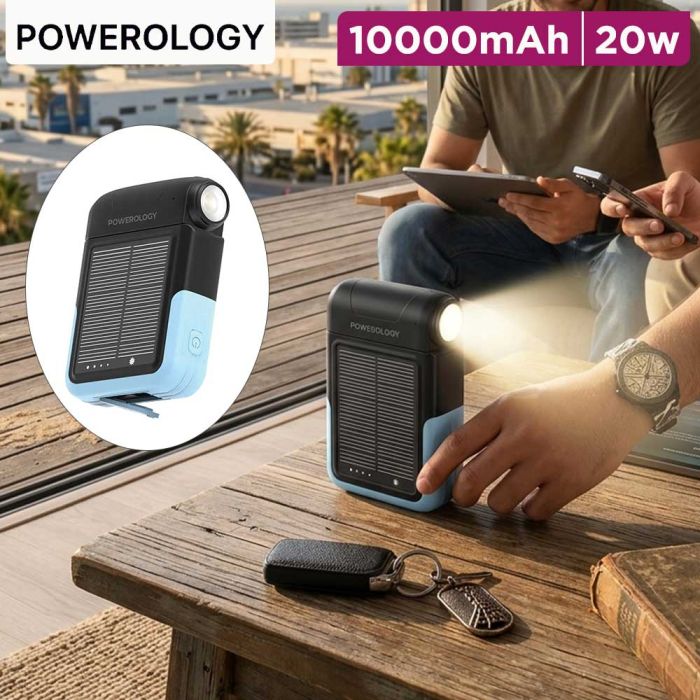
Powerology Solar 10,000mAh
Built for camping and desert trips. A solar panel provides backup top-up, and the detachable 150-lumen flashlight has its own 2,000mAh battery with multiple lighting modes. Rugged housing with overcharge, short-circuit and overheat protection.
Check Current Price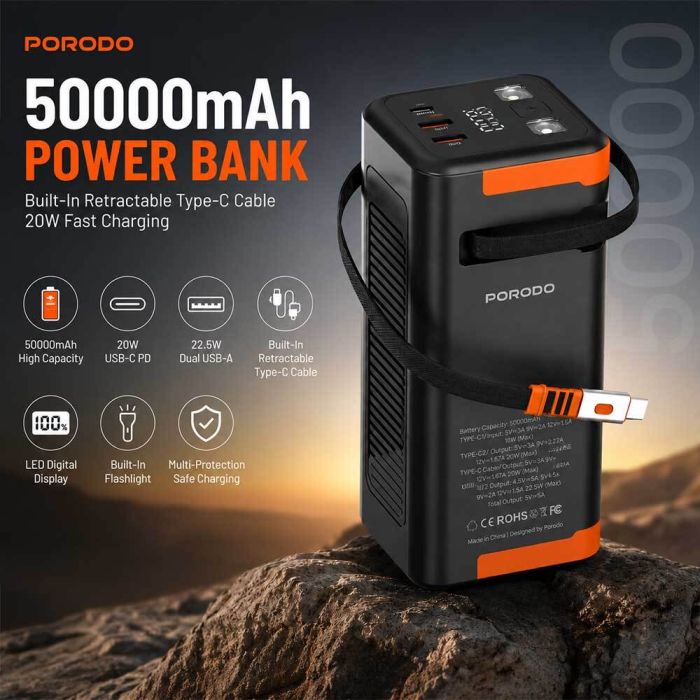
Porodo 50,000mAh - 20W
The largest capacity on this list, enough to keep a family powered for days at camp. A 70cm retractable internal cable, a digital display showing exact battery percentage, and a built-in emergency flashlight. Multiple ports for simultaneous charging.
Check Current Price
UGREEN Nexode 25,000mAh - 145W
A direct rival to the 165W Anker at the same capacity. 145W output with PD3.1 and QC3.0, two-way fast charging and a digital display showing power status. A strong pick for charging a laptop and a phone together while travelling or at work.
Check Current Price
Lisa & Gary 20,000mAh
A 20,000mAh capacity that recharges your phone more than once, in a size that suits work and travel. A practical choice if you want big capacity without complications. Check the product page for current price and availability.
Check Current PricePower bank comparison: Anker vs UGREEN vs Xiaomi
| Model | Capacity | Max output | Standout feature | Best for |
|---|---|---|---|---|
| Anker Nano | 5,000mAh | 22.5W | Foldable built-in USB-C plug | Office and campus |
| SIA MagOn | 10,000mAh | 20W | MagSafe wireless charging | iPhone users |
| Powerology Solar | 10,000mAh | 22.5W | Solar panel and detachable torch | Camping and desert trips |
| Xiaomi | 20,000mAh | 33W | Integrated cable, multiple ports | Everyday carry |
| Lisa & Gary | 20,000mAh | Not listed on product page | Big capacity, no complications | Work and travel |
| UGREEN Nexode | 25,000mAh | 145W | PD3.1 and digital display | Laptops and travel |
| Anker 165W | 25,000mAh | 165W | Charges 4 devices, smart display | Laptops and travel |
| Porodo | 50,000mAh | 20W | Emergency torch, huge capacity | Camp and long trips |
Which power bank fits your need?
| Your need | What to check before buying |
|---|---|
| Charging a laptop at work or when travelling | A USB-C port with PD and at least 65W, such as the Anker 165W or UGREEN Nexode 145W |
| iPhone with no cable | MagSafe support and a strong magnet, remembering wireless output is around 15W |
| Two days of camping with no mains power | 20,000mAh or more, with a solar panel or built-in torch |
| Office or campus pocket carry | 5,000mAh, light weight and a built-in USB-C connector |
| Flying with it | Under 100Wh in carry-on, roughly 27,000mAh at most |
| Charging two or three devices at once | Number of ports and the output of each port when used together |
If you are shopping for a laptop power bank, the real contest is between the 165W Anker and the 145W UGREEN Nexode, both at 25,000mAh. Anker brings two built-in cables and a screen showing time remaining, while the UGREEN offers PD3.1, two-way charging and a digital display. If you only need big capacity for a phone, the 20,000mAh Lisa & Gary or the 33W Xiaomi will do the job, and you avoid paying for wattage you will never use. For iPhone owners in particular, the magnetic SIA is easier day to day than any cable.
Buy for the biggest device you charge, not for your phone. The laptop decides the wattage, and the phone only decides the capacity.How to order a power bank from Sheeel, step by step
Step one: open the Power Banks & Chargers section on Sheeel, or browse the full Mobiles & E-Cards category.
Step two: pick the capacity that matches your use case from the table above, then check the wattage — this is the spec most buyers skip and later regret.
Step three: review the port types and confirm they suit your devices. If everything you own is USB-C, choose a model with a built-in Type-C cable; if you still use older gear, make sure there is a USB-A port.
Step four: add it to your cart and pay with KNET, the fastest payment method in Kuwait, or use Visa, Mastercard or Apple Pay. Your order confirms immediately.
Step five: on delivery, charge the unit fully before first use and test every port while you are still inside the exchange window.
How to make a power bank last in Kuwait's heat
- Leaving it in the car in summer: the most damaging habit in Kuwait. Cabin temperatures above 45C permanently degrade lithium cells and can cause the battery to swell.
- Draining it to zero every time: lithium batteries last far longer when kept between 20% and 80%.
- Recharging it with a weak adapter: filling a 20,000mAh bank from a 5W charger takes over ten hours. Use an adapter that matches the unit's input rating.
- Charging it inside a closed bag: trapped heat reduces efficiency and accelerates cell degradation.
- Storing it empty for months: if you are putting it away, leave it at roughly 50% and top it up every three months.
Why Kuwaitis Trust Sheeel for Power Banks
The portable battery market is full of products quoting capacities that do not exist. On Sheeel you get the full specification for every model — capacity, wattage, ports, dimensions and warranty — before you order, and the brands stocked are officially distributed names like Anker, Xiaomi, Porodo and Powerology, alongside UGREEN and Lisa & Gary.
Payment via KNET is direct with no transfers, and delivery comes from local Kuwait stock, so there is no international shipping wait and no surprise customs charges. Customer service is available 9am to 11pm on WhatsApp and phone if you want help picking the right capacity.
Related reading
Power bank FAQs
After conversion losses you get roughly 13,000mAh of usable charge. A modern phone with a 4,000 to 5,000mAh battery will get about two and a half to three full charges, and that figure drops slightly as ambient temperature rises.
Yes, but in carry-on baggage only, never checked luggage, and the usual limit is 100Wh which works out to around 27,000mAh. Units of 20,000 and 25,000mAh are generally accepted, while 50,000mAh models are refused by most airlines. Check your carrier's policy before you travel.
mAh measures the size of the tank, meaning how many times you can charge. Watts measure the flow rate, meaning how quickly your device fills. A high-capacity bank with low wattage charges a lot but slowly, and the reverse is also true. You need both to suit your use.
Yes. Magnetic wireless charging is typically 15W and loses more energy as heat, while the wired port on the same unit delivers 20W or more. The trade-off is convenience, and most magnetic models give you both options.
Never leave it in the car during summer, and do not charge it inside a closed bag or in direct sunlight. High temperature is the number one cause of lithium cell degradation and swelling. Store it somewhere shaded and dry.
Yes, provided it has a USB-C port with PD support rated at 65W minimum, and ideally 100W or higher for a powerful laptop. Units rated at 20W or 33W will charge phones and tablets only and will not be enough for a laptop.
Both are 25,000mAh and can charge a laptop. The Anker delivers 165W with two built-in cables and a smart display, while the UGREEN Nexode delivers 145W with PD3.1 and a digital display. The main differences are peak wattage and cable design, and both are available on Sheeel.
Order the Right Power Bank for Your Device Now
Pick the capacity and wattage that fit how you use it, pay with KNET, delivered across Kuwait.
Browse Power Banks on Sheeel
